

Table of Contents
- Why Buyers Are Searching for a 4allpromos Alternative for Sustainable Gifting
- What Counts as Sustainable Gifting (and What Does Not)
- Sustainable Corporate Gifts for Employees That Actually Get Used
- Custom Branded Eco-Friendly Pouches: What to Look For
- Corporate Gifting Best Practices for Eco-Conscious Teams
- How to Avoid Greenwashing When Choosing a Gifting Partner
- Frequently Asked Questions
Last Updated: September 18, 2026
Why Buyers Are Searching for a 4allpromos Alternative for Sustainable Gifting
Procurement teams are rethinking the promotional products catalog. Buyers who once ordered generic logo items now want gifts that match a company's environmental values, and many are hunting for a 4allpromos alternative for sustainable gifting because mass-market promo catalogs rarely explain where a product came from or what happens to it after the event. This guide from Conscious Cutlery walks through what sustainable gifting actually means, which items people keep, and how to spot a partner that is genuinely eco-conscious rather than just green-labeled.
What Counts as Sustainable Gifting (and What Does Not)
Sustainable gifting is the practice of choosing promotional products, employee gifts, and event favors that minimize environmental impact across their full lifecycle, from raw material sourcing through disposal. It is not simply a matter of picking a product with a green color scheme or a leaf on the packaging.
Three criteria do most of the work:
- Material sourcing. Look for recycled, natural, or renewable materials such as rPET, bamboo, wheat straw, organic cotton, hemp, and stainless steel.
- Durability and utility. A gift that lasts for years and gets used daily replaces hundreds of disposable items. That is the real environmental argument.
- End-of-life. A genuinely sustainable product has a clear disposal or recycling path. If nobody can tell you what happens to it after use, that is a warning sign.
Sustainable Corporate Gifts for Employees That Actually Get Used
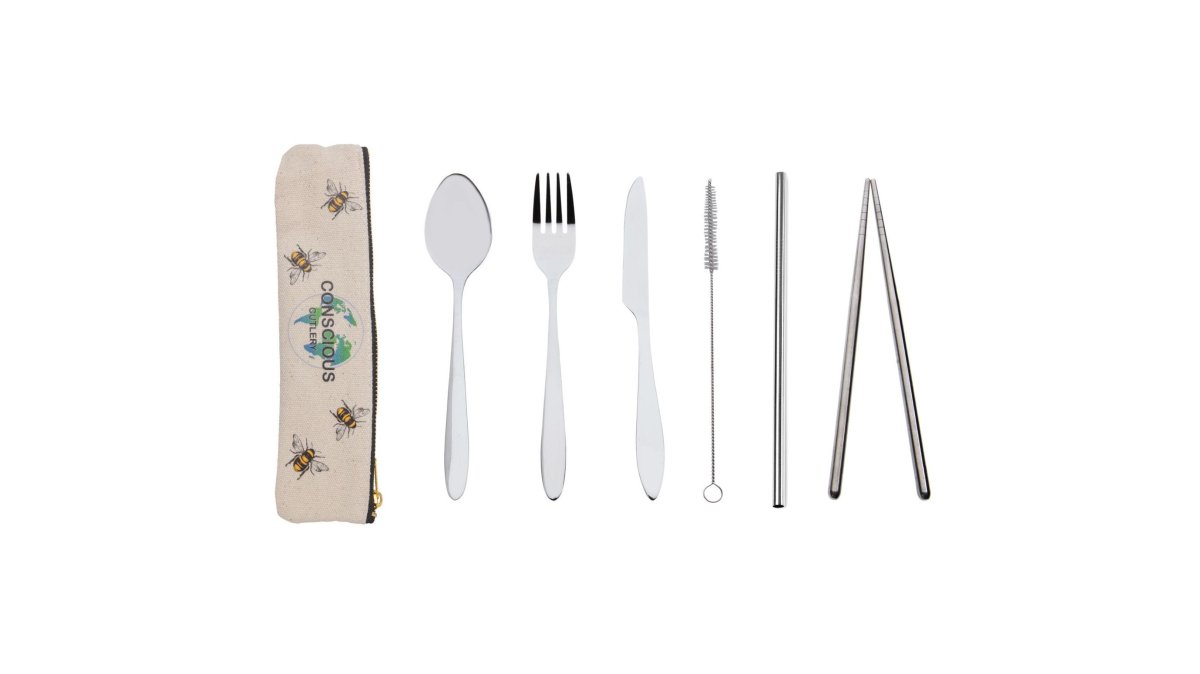
The biggest complaint about corporate swag is that it ends up in a drawer. The fix is to choose items with daily utility, and reusable cutlery sets are a strong example because they replace something people already use and dispose of constantly.

Custom Branded Eco-Friendly Pouches: What to Look For
Custom branded eco-friendly pouches are the part of a gifting order that most suppliers treat as an afterthought, and it shows. The pouch is what people touch every day, so its material and construction decide whether the gift feels considered or cheap. It is also the piece most likely to be misrepresented, because "eco-friendly" is not a regulated term on fabric.
- Fiber content, stated by weight. Ask for the percentage of each fiber, not a marketing label. "Hemp blend" can mean 5% hemp and 95% polyester. A supplier who knows their product can tell you the ratio without checking.
- Closure type. A metal zipper keeps contents secure and survives repeated use. Open pouches spill utensils into bags and get left at home. Ask whether the zipper is metal or molded plastic, the difference shows up after about a year of daily handling.
- Print area and method. Ask how the logo is applied and how it behaves after washing. Screen print on woven fabric holds up; heat-transfer vinyl can lift at the corners. Request a wash-test sample if the pouch is meant to be laundered.
- Size relative to contents. A pouch that bulges in a backpack will not travel. Compact sets get carried; bulky ones get stored.
- End-of-life path. Ask what a recipient should do with the pouch when it wears out. Natural fibers can often be composted in a municipal facility; synthetic blends generally cannot. A supplier who can answer this has thought past the sale.
Matching Pouch Material to the Gift Occasion
The right pouch depends on who receives it. A few common patterns:
| Pouch Material | Best For | Care | Design Options |
|---|---|---|---|
| Hemp and cotton | Everyday office gifts, employee appreciation | Spot clean, air dry | Bees, trees, mandala, "Plastic Sucks" |
| Cotton linen | Wedding favors, campus gifts, bookshop retail | Gentle wash | Bear, hummingbird and cactus |
| Limestone neoprene | Travel and outdoor use | Wipe clean, water-resistant | Black Mountains, pink mandala |
| Felted wool | Premium or limited-run gifts | Hand wash, air dry | Handmade owl and fox |
How to Verify Fiber and Print Claims Before You Order
A short verification sequence that costs nothing and catches most problems:
- Request a fiber composition sheet from the supplier, not just a product page. If they cannot produce one, treat the material claim as unverified.
- Ask for a physical sample with your logo printed on it. Digital mockups hide print placement drift on sewn fabric.
- Wash or wipe the sample the way a recipient would, then inspect the print. This is the single fastest test of print durability.
- Confirm the pouch is sized to the contents by packing the actual item it will hold.
Corporate Gifting Best Practices for Eco-Conscious Teams
Good corporate gifting best practices start with one rule: match the gift to how the recipient will actually use it, then let the sustainability story follow from that.
A short checklist for procurement teams:
**ON SALE** 7 Piece Travel Cutlery Set →
- Confirm the minimum order quantity fits your headcount (Conscious Cutlery's minimum is 100 pieces)
- Request material specifications in writing, not just marketing language
- Ask where the product is made and who makes it
- Confirm packaging is plastic-free or recyclable
- Get a sample before approving a bulk print run
- Ask for the disposal or recycling guidance you can pass to recipients
How to Avoid Greenwashing When Choosing a Gifting Partner
Greenwashing is the practice of making a product or company appear more environmentally responsible than it is, usually through vague claims that cannot be verified. Spotting it comes down to asking for specifics and watching how the supplier responds.
Red Flags to Watch For
- Claims like "eco-friendly" or "planet-positive" with no material detail behind them
- No information about where the product is manufactured
- Recycled content asserted but never documented
- Packaging that contradicts the product's environmental message
- No answer when you ask about disposal or end-of-life
The Three-Question Verification Framework
Ask every prospective supplier these three questions in writing. The quality of the answers tells you more than any certification badge.
- "What is the fiber or material composition, by percentage?" A supplier who manufactures or closely sources their product can answer immediately. One who resells from a catalog will pivot to price.
- "Where is the product made, and who makes it?" You are not looking for a specific country, you are looking for a specific answer. "Overseas" is not an answer.
- "What should a recipient do with this when it wears out?" This is the fastest greenwashing test. A clear answer signals a supply chain the supplier understands. Silence signals a marketing layer.
Certification Literacy: What the Common Marks Actually Mean
Certifications are useful, but only if you know what each one covers. A few that appear on promotional products and textiles:
- Global Recycled Standard (GRS), verifies recycled content in a product and traces it through the supply chain (Recycled Claim Standard (RCS) + Global Recycled Standard (GRS)). Relevant if a supplier claims rPET or recycled cotton.
- OEKO-TEX Standard 100, tests finished textiles for harmful substances (OEKO-TEX® STANDARD 100). It says nothing about recycled content or labor conditions.
- Fair Trade Certified, focuses on labor conditions and farmer or worker compensation, primarily in agricultural supply chains like cotton.
- B Corp Certification, evaluates a company's overall social and environmental performance, not a single product. Useful as a company-level signal, not a product-level one.
End-of-Life Guidance You Can Pass to Recipients
- Stainless steel utensils are recyclable through standard municipal metal recycling. They are also built to be reused for years, which is the point of choosing them over disposable alternatives.
- Hemp and cotton pouches can often be composted in a municipal facility that accepts textiles, or donated for reuse. Check local guidelines, since curbside programs vary.
- Limestone neoprene pouches are durable and long-lasting but not typically compostable. Recommend reuse or textile recycling.
Conscious Cutlery has been family-owned and operated since 2018, and the product line reflects a single consistent position: replace single-use plastic with durable stainless steel. That is a narrow claim, which is exactly what makes it credible. Broad environmental promises are hard to verify; "this set replaces disposable utensils" is not. Custom logo printing is available at a 100-piece minimum, which suits employee appreciation programs, campus bookshop orders, wedding favors, and fundraising drives.

Frequently Asked Questions
What are some ideas for sustainable gifting?
Reusable stainless steel cutlery sets with hemp or cotton pouches are a practical choice because they replace single-use plastic utensils at work and on the go. Other options include bamboo drinkware, recycled cotton tote bags, and refillable stationery. The best sustainable gifting ideas focus on items people will use daily, not items that sit in a drawer. Custom branded eco-friendly pouches also work well for wedding favors, fundraising, and college bookshops.
How do I choose a sustainable promotional products vendor?
Ask three questions: Where do the materials come from, how is the product packaged and shipped, and what happens when the item reaches end of life? A vendor that cannot answer these clearly is a risk. Look for certifications, fair trade claims you can verify, and a minimum order quantity that matches your budget. Conscious Cutlery, for example, uses 18/8 stainless steel and hemp or cotton pouches with a 100-piece minimum for custom orders.
What is the minimum order for custom branded eco-friendly pouches?
Conscious Cutlery requires a minimum order of 100 pieces for custom logo printing on pouches. This works for corporate gifts, wedding favors, fundraising items, and college bookshop orders. Bulk pricing applies at that threshold, and the pouches come in designs like bees, trees, mandala, and mountains. Each set includes a fork, spoon, knife, straw, straw brush, and chopsticks in 18/8 stainless steel.
How do I avoid greenwashing in corporate gifting?
Greenwashing happens when a product is marketed as eco-friendly but the supply chain, packaging, or disposal does not support the claim. Ask for material sourcing details, check whether the item is reusable or just recyclable, and request packaging information. Avoid vendors that use vague terms like 'natural' without proof. A 4allpromos alternative for sustainable gifting should be able to show you exactly what the product is made of and how it reduces waste.
Why is sustainable corporate gifting important for company culture?
Employees notice when a gift aligns with the company's stated values. A reusable cutlery set that replaces disposable plastic at lunch sends a consistent message about sustainability. It also reduces waste in the office and gives employees a tool they can use daily. Corporate gifting best practices include choosing items with utility, durability, and a clear environmental benefit, not just a logo on a cheap item.