

Table of Contents
- EcoBranders vs ExecutiveAdvertising for Custom Swag: What Actually Matters
- Side-by-Side Comparison: EcoBranders and ExecutiveAdvertising
- Sustainable Corporate Gifts for Employees: How the Two Vendors Compare
- Custom Branded Eco-Friendly Merchandise: Materials, Durability, and Branding Options
- Minimum Order Quantities and Pricing Realities for Custom Swag
- Where EcoBranders and ExecutiveAdvertising Each Win: Use-Case Recommendations
- Sustainability Impact Reporting and Procurement Integration: The Gaps Competitors Miss
- Conclusion: Choosing the Right Vendor for Your Custom Swag Program
- Frequently Asked Questions
Last Updated: October 4, 2026
EcoBranders vs ExecutiveAdvertising for Custom Swag: What Actually Matters
EcoBranders and ExecutiveAdvertising both promise custom branded eco-friendly merchandise that makes your company look good without wrecking the planet.
Here is the truth most vendor comparisons skip: the platform matters far less than the product you put your logo on.
Custom swag is branded merchandise given away to employees, clients, or event attendees, chosen to keep your company visible in daily life.
Side-by-Side Comparison: EcoBranders and ExecutiveAdvertising
Neither vendor is a clear overall winner. EcoBranders leans into sustainable materials and eco-conscious positioning, while ExecutiveAdvertising wins on catalog breadth and established corporate gifting relationships.
Here is how they stack up on the criteria procurement managers actually weigh:
| Criteria | EcoBranders | ExecutiveAdvertising |
|---|---|---|
| Sustainability focus | Strong, core positioning | Moderate, growing category |
| Catalog breadth | Eco-focused selection | Broad general merchandise |
| Custom branding options | Screen printing, some engraving | Screen printing, embroidery, engraving |
| Bulk procurement support | Standard | Established corporate accounts |
| Lead times | Varies by product | Varies by product |
| Best for | Eco-first brand identity | Variety-first programs |
Both vendors are intermediaries: they source from suppliers, decorate in-house or through partners, and ship to you. The durability of your custom swag depends on the specific product you select, not the vendor's brand name.
Sustainable Corporate Gifts for Employees: How the Two Vendors Compare
Sustainable corporate gifts for employees live or die on one question: will the recipient actually keep and use this? Both vendors offer recycled-content and reusable options, but quality varies widely.
A common mistake is treating "sustainable" as a single checkbox. It covers a spectrum: some items use recycled content in packaging only, while others genuinely replace a disposable product over years of use.
For employee gifts people genuinely carry, reusable everyday items outperform novelty eco-gifts. A branded reusable utensil set that lives in a lunch bag gets seen daily, far more brand exposure than a decorative item on a shelf.
Custom Branded Eco-Friendly Merchandise: Materials, Durability, and Branding Options
Materials decide durability, and durability decides whether your custom branded eco-friendly merchandise survives past the first month. The main choices are recycled plastics, natural fibers like hemp and cotton, bamboo, and stainless steel.

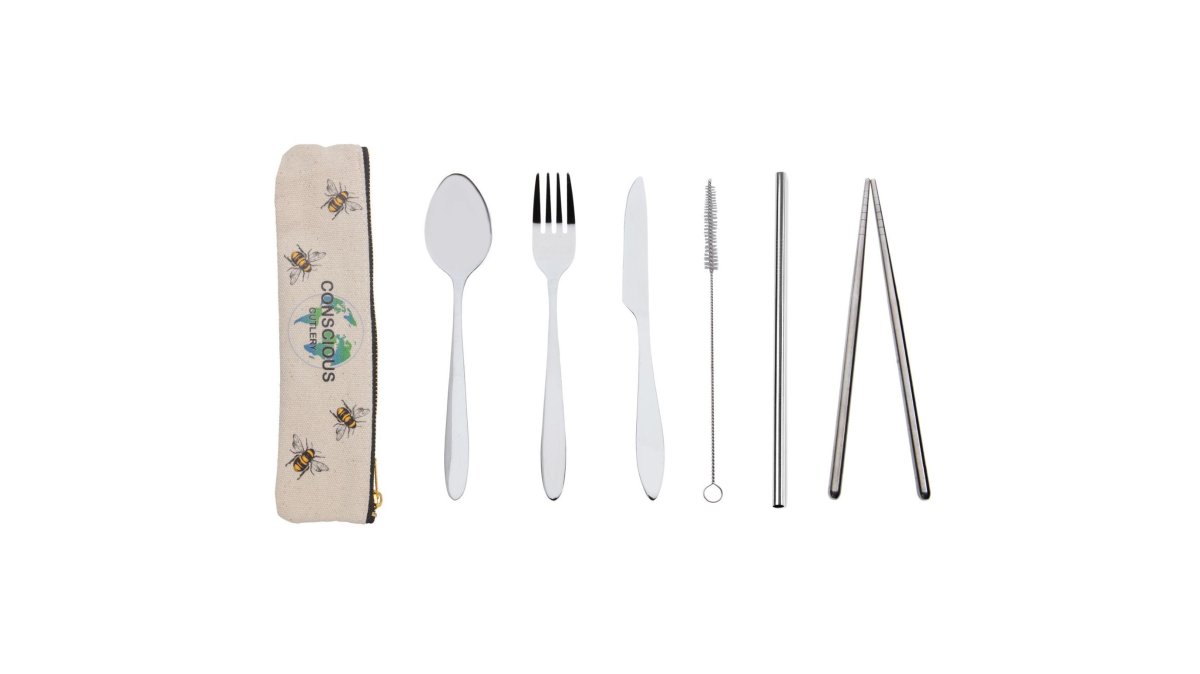
Stainless steel is the standout for longevity: it resists rust, holds up to daily washing, and does not splinter or crack the way bamboo can.
We offer custom logo printing for corporate programs. Complex multicolor logos on natural fiber pouches often print with softer edges than on synthetics, so request a physical proof before a large run.
Minimum Order Quantities and Pricing Realities for Custom Swag
Minimum order quantities and per-unit pricing swing widely depending on the item and decoration method, so treat any quote as specific to that exact product.
Here is the practical framework we would use to evaluate any quote:
- Base unit cost: the undecorated item price
- Decoration setup fee: a one-time charge per logo or color
- Per-unit decoration cost: often drops as quantity rises
The mistake buyers make is comparing only the headline unit price. A vendor with a lower unit cost but higher setup fees and slower lead times can cost more once you factor in your team's time.
How MOQs Are Actually Set
MOQ is the point at which a production run becomes economically viable, driven by three inputs:
- Blank item minimum from the supplier. If the factory will not run fewer than a certain quantity, the vendor cannot sell below it without holding inventory.
- Decoration setup. Screen printing requires a screen per color; each screen has a fixed setup cost that only amortizes across enough units. Pad printing, embroidery digitizing, and laser engraving each carry their own one-time setup.
- Order handling. Picking, packing, and shipping a small order costs nearly the same in labor as a large one, so vendors push the threshold up.
That is why the same vendor can quote a 50-piece minimum on a stock tote and a 250-piece minimum on a custom-dyed item. MOQ is a function of product and decoration, not the vendor's brand.
The Real Metric: Total Landed Cost Per Usable Unit
The number that matters is total landed cost divided by the units a recipient actually keeps and uses.
Total landed cost includes:
7 Piece Travel Cutlery Set With Hemp Pouch BEES →
- Base unit cost × quantity ordered
- One-time setup fees (screens, digitizing, dies)
- Per-unit decoration cost × quantity
Divide that total by the units that survive past month one in a recipient's hands, and you get a defensible cost-per-impression figure. A cheap item that gets thrown away has an infinite cost per usable unit; a pricier item that lives in a lunch bag for two years has a very low one.
Over-Ordering Is a Real Cost
If your event needs 120 units and the MOQ is 250, you either over-order or switch products. Over-ordering ties up budget, takes up storage, and dilutes the gift's perceived value. Know your number before you shop, and treat any MOQ above your headcount as a signal to look at a different product.
A Worked Example of the Trade-Off
Suppose Quote A has a lower base unit cost but a higher setup fee and longer lead time; Quote B costs more per unit but has a lower setup fee and ships in half the time. For a one-time order of 100 units, Quote A may win on paper. For a recurring program with quarterly reorders, Quote B usually wins because the setup fee is paid once and the shorter lead time reduces the risk of missing an event date.
Where a 100-Piece Minimum Fits
A 100-piece minimum is a practical threshold for corporate gifting, employee appreciation, and event giveaways. It is low enough to serve a single department or mid-sized event without forcing over-ordering, and high enough to make decoration setup worthwhile. If your headcount sits between 100 and 300, you can order close to your actual need rather than padding the count.
Where EcoBranders and ExecutiveAdvertising Each Win: Use-Case Recommendations
EcoBranders wins when your brand identity is built on sustainability and the merchandise must reinforce that story. If your company publishes a sustainability report or markets itself on environmental values, an eco-specialist keeps your swag consistent.
ExecutiveAdvertising wins when you need variety and established corporate account handling. If you are sourcing a mixed order across many item types and want one vendor to manage it, their broader catalog simplifies procurement.
A Scenario-Based Decision Matrix
| Your situation | Better fit | Why |
|---|---|---|
| Brand is publicly tied to sustainability commitments | EcoBranders | Catalog and messaging align with an eco-first identity you can defend in a report |
| Mixed order across many item types, one PO | ExecutiveAdvertising | Broader catalog and established corporate account handling reduce vendor count |
| Single hero item for a recurring employee program | Either, but product selection dominates | Vendor brand matters less than the specific SKU's durability and replacement cost |
| Event with a hard date and tight lead time | Whichever can confirm a production slot in writing | Lead times vary by product, not by vendor, so get the date in the quote |
| Small run near 100 units | Whichever meets your MOQ without forcing over-order | Over-ordering dilutes value and ties up budget |
| Need order-level impact data for reporting | Neither reliably; plan to estimate | Most vendors cannot supply per-order carbon or plastic-avoided figures |
| Need punch-out or API integration with procurement software | Neither reliably; plan for manual process | Most promotional vendors operate outside standard procurement systems |
The Questions That Actually Decide It
Before you pick either vendor, get written answers to these five questions:
- What is the MOQ for this exact SKU with my exact decoration method? Not the category MOQ, the SKU MOQ.
- What is the confirmed production and ship date if I approve the proof by [date]? Lead time is the most common cause of missed events.
- Can you provide a physical pre-production proof? Digital proofs hide print quality problems on textured materials.
- What is the per-order impact data you can supply? If the answer is vague, plan to estimate internally.
- How do reorders work? Is the setup fee charged again, and is the original artwork retained?
Where Both Fall Short
Where both fall short is the product itself. Neither vendor is a manufacturer; they decorate and resell. If you want a reusable item your team will actually use daily, product selection matters more than the vendor logo on the invoice.
That is the gap we built our business around. Our reusable stainless steel utensil sets are designed to replace disposable cutlery in daily life, not sit in a drawer.
Sustainability Impact Reporting and Procurement Integration: The Gaps Competitors Miss
Two areas where nearly every vendor in this space leaves buyers under-served: sustainability impact reporting and procurement software integration.
On impact reporting, most vendors can confirm recycled content but cannot give a per-order figure for plastic avoided or carbon footprint.
On procurement integration, most promotional vendors run orders through email and manual quotes rather than a punch-out catalog or API.
Conclusion: Choosing the Right Vendor for Your Custom Swag Program
The hard part is not picking a vendor. It is finding merchandise durable enough that your investment in custom swag pays off in daily use. If your team needs reusable items that replace disposables and carry your logo everywhere, Conscious Cutlery makes 18/8 food-grade stainless steel utensil sets with custom logo printing, a 100-piece minimum order, and a hemp and cotton pouch that keeps the whole set together.
Frequently Asked Questions
What criteria should companies use to evaluate sustainable swag vendors like EcoBranders and ExecutiveAdvertising?
Start with material transparency: ask for the exact composition of each item (e.g., 18/8 stainless steel, hemp, organic cotton). Check minimum order quantities and whether they fit your headcount. Request samples to test durability and branding quality. Confirm shipping packaging is plastic-free if that aligns with your goals. Finally, ask for documentation on ethical sourcing and end-of-life options. These criteria help you compare vendors objectively rather than relying on marketing claims.
Are there minimum order requirements for sustainable corporate gifts?
Yes, most promotional product vendors enforce minimums. EcoBranders and ExecutiveAdvertising typically require 100 pieces or more for custom orders. Conscious Cutlery also has a 100-piece minimum for custom printed pouches. This threshold ensures production efficiency and keeps per-unit costs reasonable. If you need fewer than 100, consider stock designs without customization or combine orders across departments to meet the minimum.
What are the benefits of choosing reusable stainless steel over plastic swag?
Reusable stainless steel cutlery sets, like those from Conscious Cutlery, replace single-use plastic utensils that often end up in landfills. Stainless steel is durable, rust-resistant, and dishwasher safe, so recipients can use it daily for years. Unlike plastic, it does not leach chemicals or break easily. For companies, steel swag signals a genuine commitment to sustainability, which strengthens brand identity and employee appreciation.
How can businesses ensure their corporate gifts align with ESG goals?
Choose vendors that provide detailed material sourcing and carbon footprint data. Prioritize items made from recycled or natural materials, such as hemp or organic cotton pouches, and avoid single-use plastics in packaging. Ask about ethical sourcing certifications and end-of-life recycling options. For example, Conscious Cutlery's stainless steel sets are designed for longevity, reducing waste. Document these choices in your ESG report to demonstrate measurable impact.
How does the product selection differ between EcoBranders and ExecutiveAdvertising?
EcoBranders focuses exclusively on eco-friendly merchandise, offering items like recycled notebooks, bamboo drinkware, and organic cotton apparel. ExecutiveAdvertising has a broader catalog that includes both sustainable and conventional promotional products, such as tech accessories and branded pens. If your priority is a curated sustainable selection, EcoBranders may be a better fit. If you need a mix of eco and traditional items, ExecutiveAdvertising provides more variety.