

Table of Contents
- Step 1: Run a Waste Audit to Find Your Biggest Plastic Sources
- Step 2: Build a Plan for Reducing Single-Use Plastic in the Workplace
- Step 3: Swap Breakroom Disposables for Reusable Alternatives
- Step 4: Fix Recycling Contamination with Better Bins and Signage
- Step 5: Make Sustainable Office Practices Stick with Staff Buy-In
- Step 6: Use Eco-Friendly Corporate Gifts to Spread Reusable Habits
- Step 7: Work Suppliers and Vendors into Your Waste Management Strategy
- Common Mistakes to Avoid
- Frequently Asked Questions
Last Updated: September 16, 2026
Step 1: Run a Waste Audit to Find Your Biggest Plastic Sources
Learning how to reduce plastic waste at work starts with measurement, not guesswork. A waste audit is a structured count of what your office throws away over a set period, sorted by material type. At Conscious Cutlery, we've watched plenty of well-meaning green teams ban straws while the real culprit sat in the breakroom: pallets of disposable forks, spoons, and knives ordered on autopilot.
What to Count and How Long to Track It
Track for two weeks minimum, ideally four. One week catches anomalies; four weeks shows the pattern. Count these categories:
- Disposable cutlery and stirrers
- Cups, lids, and straws
- Food packaging from takeout and catered lunches
- Bottled water and beverage containers
- Shipping and supply packaging
Turning Audit Data into Waste Reduction Targets
Convert counts into a baseline. If your breakroom goes through 500 disposable forks a week, that's your number to beat. Set a waste reduction target against it, say 30% in the first quarter, and write it down where people can see it.
Step 2: Build a Plan for Reducing Single-Use Plastic in the Workplace
A plan turns audit numbers into commitments. Reducing single-use plastic in the workplace needs three things: a baseline, a named owner, and a deadline. Without an owner, sustainability initiatives quietly die in a shared inbox.
Set Baselines, Owners, and Deadlines
Assign each target to a person, not a department. "Facilities reduces cutlery orders by half by March" beats "the company will reduce waste" every time.
Pair Every Ban with a Reusable Alternative
This is where most programs fail. Remove disposable forks without providing an alternative and people buy their own plastic ones. Every removal needs a replacement ready on day one: real dishware, refillable stations, or a reusable set per employee.
Step 3: Swap Breakroom Disposables for Reusable Alternatives
The breakroom is usually the single biggest source of office plastic, and the easiest to fix. Real dishware, a working dishwasher, and refillable stations cover most of it.
Refillable Stations, Bulk Purchasing, and Real Dishware
Set up a water refill station and retire bottled water. Stock ceramic mugs and metal utensils instead of disposables. Buy coffee, sugar, and snacks in bulk rather than single-serve packets. Bulk purchasing cuts both packaging waste and cost per serving, which makes the finance conversation easier.
Step 4: Fix Recycling Contamination with Better Bins and Signage
Recycling contamination happens when the wrong items land in the wrong bin, and it can send an entire load to landfill. In practice, most contamination traces back to confusing signage, not careless staff.
Bin Signage That People Actually Follow
Put bins side by side, never scattered. Label each with photos of accepted items, not just words. Add a lid with a shaped opening for bottles and cans; physical constraints work better than instructions.
| Bin | Accepts | Common Mistake |
|---|---|---|
| Recycling | Clean bottles, cans, paper | Greasy food containers |
| Compost | Food scraps, napkins | Plastic wrappers |
| Landfill | Everything else | Recyclables tossed in haste |
Step 5: Make Sustainable Office Practices Stick with Staff Buy-In
Sustainable office practices survive on habit, not policy. People follow what their colleagues do, so make the visible behavior the easy one. The gap most guides leave open is the mechanics: how you actually run a program that keeps participation high after the novelty wears off, and how you adapt it when half the team is working from home three days a week.
Gamify Participation and Track Progress Publicly
Post monthly waste numbers where everyone walks past them. Run a friendly competition between floors or teams. Small recognition, a coffee run, a shout-out in the staff meeting, keeps participation high without a budget. The mechanics matter more than the idea:
- Pick one metric per cycle. Weight of landfill-bound breakroom waste is the easiest to measure and the hardest to argue with. Do not track five things at once.
- Set a short cycle. Two to four weeks. Long enough to show a trend, short enough that people remember they are playing.
- Make teams small. Floors, departments, or lunch groups of five to fifteen people. Large teams dilute individual effort.
- Publish a leaderboard. A whiteboard near the breakroom or a slide in the weekly all-hands. Visibility is the reward.
- Reward the behavior, not the outcome. Recognize the team that ran the refill station, not just the team that hit the number, so people who cannot control the metric still get credit.
Build Incentives That Do Not Require a Budget
Recognition beats cash for most workplace programs. A reserved parking spot for a month, first pick of the snack drawer, a half-day of flexible time, or a feature in the company newsletter all cost little and get remembered. If you do have a small budget, spend it on the reusable infrastructure (a better dishwasher, more mugs) rather than prizes, because infrastructure keeps working after the competition ends.
Handle the Hybrid and Remote Work Reality
Hybrid schedules mean fewer people in the office but the same disposable stock arriving. Some teams find that a smaller onsite headcount actually increases waste per person, because leftovers get tossed instead of shared. Adjust order quantities to actual occupancy, and support remote staff with reusable options they can keep at home.
The operational fixes are specific:
- Right-size the order. If average daily occupancy dropped from 80 to 45, cut the disposable order proportionally. Most offices keep ordering at pre-hybrid levels for months because no one owns the number.
- Shift to a per-desk model. Give each regular onsite employee a labeled mug and utensil set that stays at their desk. Shared dishware works, but personal sets get used more and disappear less.
- Send reusable kits home. A compact utensil set and a refillable bottle for remote staff removes the lunchtime takeout plastic that never shows up in your office audit but still belongs to your program.
- Rethink catering. For hybrid all-hands, order platters and real serving ware instead of individually wrapped boxed lunches. The per-person packaging drop is immediate.
- Track remote waste separately. A short quarterly survey asking remote staff how often they use disposable cutlery or bottled water gives you a baseline you can act on.
Close the Loop with New Hires
New-hire onboarding is the highest-leverage moment for habit formation. Include a reusable utensil set or a custom printed pouch with the welcome materials, explain the breakroom system on day one, and the default behavior is set before old habits arrive. For campus programs, the same logic applies to incoming student kits: the item a student receives in week one is the item they carry for four years.

Step 6: Use Eco-Friendly Corporate Gifts to Spread Reusable Habits
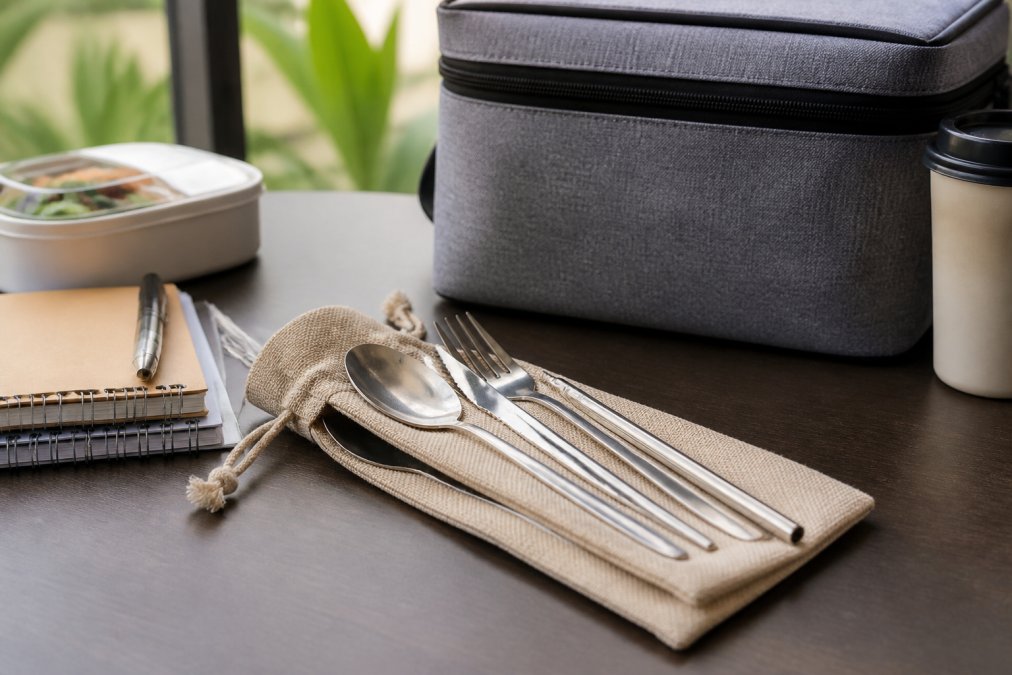
Eco-friendly corporate gifts work best when they replace something people already use daily. A reusable utensil set does more for your plastic footprint than another branded tote bag.
What Makes a Gift Actually Get Used
The best gifts are compact, durable, and immediately useful. A set that fits in a lunch bag or backpack gets carried; a bulky one stays in a drawer.
Ordering in Bulk: Minimums, Customization, and Packaging
Conscious Cutlery prints custom logos for corporate and event orders, and the minimum order is 100 pieces, which suits a department rollout, a new-hire batch, or a college bookstore order for incoming students. Ask about packaging too. If you're buying reusable goods to cut plastic waste, a plastic-wrapped shipment undercuts the whole point.
Step 7: Work Suppliers and Vendors into Your Waste Management Strategy
Your supply chain often decides how much waste enters the building. Packaging waste arrives before anyone in your office touches it, which means the most effective plastic-reduction lever is often a contract clause, not a breakroom sign. This is the step most offices skip, and it is the one that compounds: every shipment you receive either adds to the waste stream or removes from it, and that decision is made at the procurement stage, months before the pallet arrives.
Add a Procurement Policy Clause for Packaging Waste
Add one line to your procurement policy: suppliers must minimize single-use packaging and take back or consolidate shipping materials where possible. Put it in writing, and make it a scored criterion in vendor selection rather than a preference. A clause that lives only in a policy PDF changes nothing; a clause that appears in the request for proposal (RFP) scoring sheet changes which vendor wins.
A workable clause covers four things:
- Packaging minimization: the supplier ships in bulk, uses recyclable or compostable outer packaging, and avoids polystyrene foam, shrink wrap, and single-use plastic void fill.
- Take-back or reuse: the supplier accepts return of pallets, totes, and shipping containers, or uses a reusable container program.
- Documentation: the supplier reports packaging materials by type on each invoice or quarterly, so you can track progress against your audit baseline.
- Substitution: where a plastic component is unavoidable, the supplier proposes a fiber, glass, or metal alternative with a timeline.
Score Vendors on Packaging, Not Just Unit Price
The cheapest unit price often carries the highest waste cost. A supplier who ships in bulk with minimal packaging can beat a lower-priced one once disposal and handling are counted. Build a simple weighted scorecard: unit price, packaging waste per shipment, take-back availability, and reporting capability.
Run the Cost-Benefit Math Before You Pitch It
Leadership approves sustainability programs when they see a payback period, not a mission statement. The math is straightforward and does not require a consultant:
- Baseline the disposable spend. Pull twelve months of invoices for disposable cutlery, cups, plates, bottled water, and single-serve condiments. That is your annual disposable line.
- Baseline the disposal cost. Ask your waste hauler for the current per-pickup charge and the number of pickups per month. Reducing volume can sometimes drop you to a smaller container size or fewer pickups, which is a hard dollar saving.
- Estimate the reusable investment. Real dishware, a commercial dishwasher if you do not have one, refill stations, and a reusable set per employee. Amortize over a three-year life.
- Compare. Most offices find the reusable investment pays back within one to three years on disposables alone, before counting disposal savings, reduced restocking labor, and the procurement leverage from bulk purchasing.
Put It in the Contract, Not the Culture Deck
Culture statements do not bind suppliers; contract language does. Add the packaging clause to your standard terms and conditions, reference it in every purchase order, and review compliance at the quarterly business review. When a supplier cannot meet the clause, ask for a written improvement plan with dates.
Where Custom Printed Pouches Fit
If your office already hands out reusable items, the packaging those items arrive in matters as much as the items themselves. A reusable utensil set or promotional pouch that ships wrapped in plastic undercuts the program before an employee opens it.
Common Mistakes to Avoid
- Banning disposables without providing reusable alternatives
- Skipping the waste audit and guessing at the biggest source
- Scattering bins instead of placing them together with clear signage
- Ordering reusable gifts that are too bulky to carry
- Ignoring packaging from suppliers and focusing only on employee habits
Frequently Asked Questions
What are the most effective ways to reduce plastic waste in an office setting?
Start with a two-week waste audit of breakroom and kitchen bins to find your biggest sources, then replace those items directly. The highest-impact swaps are refillable water stations instead of bottled water, reusable cutlery and dishware instead of disposable sets, and bulk condiments instead of single-serve packets. Pair each change with clear bin signage so recyclables stay clean. Setting waste reduction targets and reviewing them quarterly keeps the program from stalling after the first month.
How can reusable stainless steel utensils help reduce office waste?
A single employee eating lunch at their desk five days a week can go through roughly 250 disposable forks, knives, and spoons a year. A reusable set replaces all of them for years, and 18/8 food-grade stainless steel resists rust and holds up in the dishwasher. Kits that include a straw and chopsticks also cover takeout drinks and Asian meals, two categories disposable cutlery rarely handles well. For a 100-person office, that is thousands of disposable items removed annually.
How do we implement a plastic reduction policy without employees ignoring it?
Make the reusable option easier than the disposable one. Put refillable stations and dishware within arm's reach of where people already eat, remove disposable stock from the supply closet, and explain the why behind each change. Gamify participation with team-level waste diversion scores or a monthly leaderboard, and share results publicly. Policies that rely only on rules tend to fade; policies that remove friction and add friendly competition hold up over time.
Do eco-friendly corporate gifts actually change employee habits?
They do when the gift is something people will carry daily. A compact travel cutlery set with a hemp or cotton pouch fits in a backpack or lunch bag, so it is on hand when someone grabs takeout. Custom logo printing turns it into a visible reminder of the program rather than a drawer item. Ordering in bulk also lets you equip an entire team at once, which matters because habit change spreads faster when everyone around you is doing it too.
Most offices don't fail at plastic reduction because people don't care. They fail because the reusable option isn't there when someone needs it. Conscious Cutlery exists to close that gap with 18/8 stainless steel utensil sets, hemp and cotton pouches, and custom logo printing for corporate and event orders, all starting at a 100-piece minimum. Get started with Conscious Cutlery and give your team a set they'll actually carry.