

Table of Contents
- Stainless Steel vs Plastic Cutlery: A Quick Comparison
- Durability and Longevity
- The Benefits of Stainless Steel Utensils for Everyday Use
- Environmental Impact: Reusable vs Single-Use
- Choosing a Reusable Cutlery Set with Case
- The Best Eco-Friendly Cutlery for Corporate Gifts and Events
- Common Myths and What to Ignore
- Conclusion: Making the Switch
- Frequently Asked Questions
Last Updated: September 17, 2026
Stainless Steel vs Plastic Cutlery: A Quick Comparison
The stainless steel vs plastic cutlery debate comes down to one question: do you want utensils you use once, or utensils you use for years? Stainless steel wins on durability, food safety, and environmental impact. Plastic wins on upfront convenience and nothing else.
Most comparison guides treat this as personal preference. It isn't. The two materials behave differently in heat, in the dishwasher, and in your body, and once you see how each performs, the choice stops being close.
Durability and Longevity
Stainless steel cutlery lasts for years, often decades, while plastic cutlery is designed to be discarded after a single meal. That gap is the entire story.
A quality stainless steel utensil resists bending, scratching, and corrosion thanks to its chromium content. Plastic forks flex, crack, and stain, a hot dish can warp them mid-meal. The practical math matters more than the materials science: one reusable set replaces hundreds of disposable forks over its life.
Food Safety and Chemical Leaching
Food safety is the strongest argument for stainless steel, and it's the one most people underestimate.
Plastic utensils can release chemicals when exposed to heat, acidic foods, or repeated washing. The concerns center on additives used to soften and stabilize plastic, some of which have raised health questions in ongoing research. According to the FDA's guidance on food contact substances, materials that touch food must meet safety standards, but that doesn't mean they're inert under heat.
Stainless steel is non-porous. It doesn't absorb odors, harbor bacteria in scratches, or leach into your food. That's why it's the standard in commercial kitchens and hospitals.
The Benefits of Stainless Steel Utensils for Everyday Use
The benefits of stainless steel utensils show up fastest in daily routines: dishwasher safe, flavor-neutral, and solid in the hand.
Why the material behaves the way it does
Stainless steel is an alloy of iron, chromium, and usually nickel. The chromium is the active ingredient: it forms a thin, self-repairing oxide layer that blocks rust and corrosion. Grade matters. 18/8 (also written 18/10) means roughly 18% chromium and 8-10% nickel, the ratio used in most food-grade flatware because it resists pitting from acidic foods. Lower grades (often sold as "18/0") skip the nickel, making them cheaper but more prone to staining and a faint metallic taste.
Heat, cold, and the dishwasher
Stainless steel won't warp in a hot car, soften in a microwave, or deform under a hot casserole, and it's dishwasher safe at any normal cycle temperature. Plastic softens well below boiling, which is why a plastic fork left in a hot takeout container bends.
Ergonomics and accessibility, the angle most guides ignore
Weight and grip are not trivial. For people with arthritis, limited hand strength, or tremor, a heavier utensil with a thicker handle is often easier to control than a thin, flexible plastic one, steel's heft steadies the hand, while plastic's flex can make fine motor tasks harder. Very heavy flatware can fatigue some users, so a mid-weight set (roughly 50-70 grams per piece) is the sweet spot.
Cookware compatibility, a quick matrix
This is where a lot of non-stick pans get ruined.
| Cookware surface | Stainless steel utensil | Plastic utensil |
|---|---|---|
| Non-stick (PTFE/ceramic-coated) | Can scratch the coating, avoid or use carefully | Safe for the coating, but can melt if left in a hot pan |
| Cast iron | Safe; won't damage seasoning | Safe, but can melt at high heat |
| Stainless steel pans | Safe | Safe, but can scratch |
| Enameled cast iron | Safe if edges are rounded | Safe |
| Carbon steel | Safe | Safe, but can melt |
The practical rule: keep a separate stainless set for eating and a silicone or wood set for cooking in non-stick pans. Don't cook with your flatware.
The honest drawbacks
Steel is heavier than plastic and conducts heat, so a metal spoon left in a simmering pot gets hot. It can also scratch non-stick coatings. A very cheap set with rough edges or a low grade will taste metallic and stain. None of these are reasons to choose plastic; they're reasons to buy a decent set.
- Dishwasher safe and easy to sanitize
- Non-porous surface resists bacteria and stains
- No melting, warping, or heat damage at normal kitchen temperatures
- Naturally weighted for comfortable grip, with accessibility benefits for some users
- Recyclable at end of life (see the environmental section below)
Environmental Impact: Reusable vs Single-Use
Reusable cutlery beats single-use plastic on environmental impact by simple arithmetic: one steel set used daily replaces a stream of disposables. But the story has two layers most guides skip, what happens to plastic while you're using it, and what happens after you're done.
The microplastic problem nobody talks about
Most articles focus on chemical leaching, additives migrating out of plastic into food. That's real, but only half the picture. The other half is physical: plastic utensils shed microplastics into food and drink during normal use, and the shedding worsens with heat, acidic foods, and mechanical action like stirring or scraping.
**ON SALE** 7 Piece Travel Cutlery Set →
Stir a hot pot of chili with a plastic spoon and the surface softens, the spoon flexes against the pot, and microscopic bits break off into the food, invisible, tasteless, but there. The same happens, to a lesser degree, when a plastic fork scrapes a takeout container.
Stainless steel doesn't shed.
End-of-life: what actually happens to each material
"Recyclable" and "recycled" are not the same thing, and the two materials have very different end-of-life realities.
The carbon math, briefly
A reusable set's carbon footprint is front-loaded: most of its impact happens at manufacturing, after which the per-use impact is near zero for years. A disposable fork's footprint is small per item but incurred every single time. Over a few years of daily use, the reusable set wins decisively.
If you're choosing between materials for a gift or a bulk order, the end-of-life question is worth asking out loud: will this item still be useful in five years, and can it be recycled when it finally wears out? Stainless steel answers yes to both. Single-use plastic answers no to both.
Choosing a Reusable Cutlery Set with Case
A reusable cutlery set with case solves the problem that kills most good intentions: losing your utensils. The case keeps the set together, protects it from your bag, and makes it easy to grab on the way out.

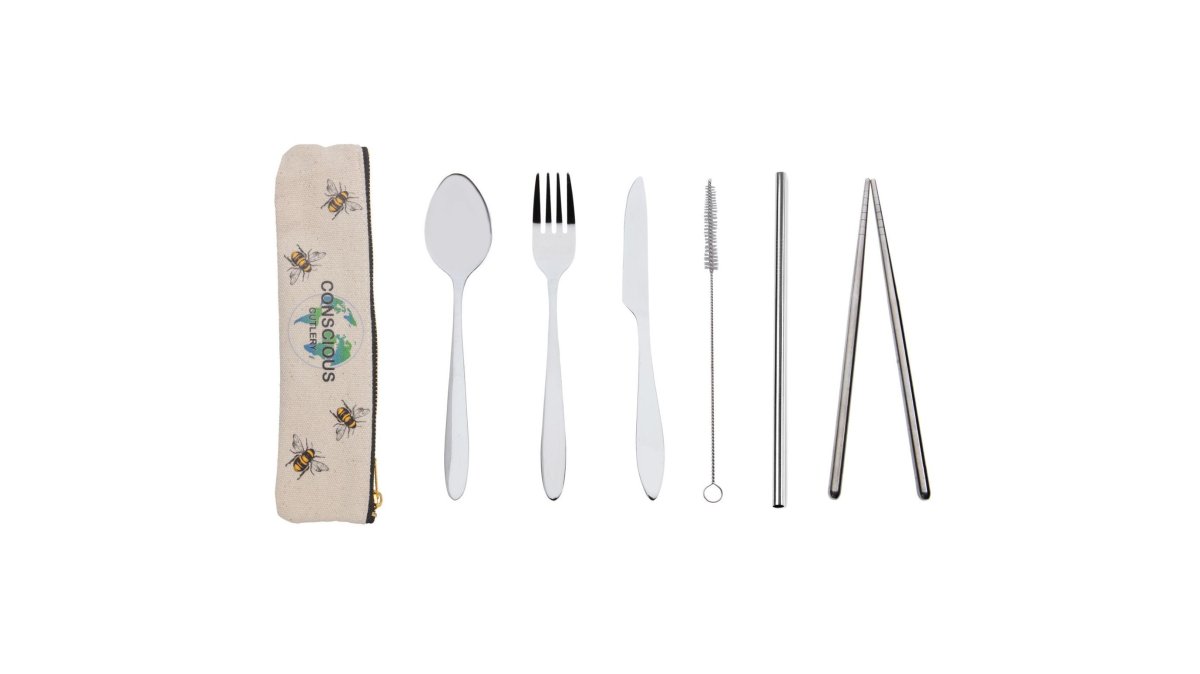
When you're comparing options, focus on four things:

| What to Check | Why It Matters | What to Look For |
|---|---|---|
| Material grade | Determines rust resistance | 18/8 food-grade stainless steel |
| Case material | Affects durability and washability | Hemp, cotton linen, or neoprene |
| Set contents | Covers your actual meals | Fork, spoon, knife, straw, chopsticks |
| Portability | Decides whether you carry it | Fits a standard lunch bag or backpack |
The Best Eco-Friendly Cutlery for Corporate Gifts and Events
The best eco-friendly cutlery for corporate gifts is a set people will actually carry, because a gift that sits in a drawer sends no message at all.
- BEES for a natural, warm aesthetic
- MANDALA for a calm, patterned look
- TREES for an outdoors-oriented feel
- PLASTIC SUCKS for a bold, statement-making option
- Felted Owl for a handmade, artisan gift
Common Myths and What to Ignore
Three myths keep circulating about the stainless steel vs plastic cutlery choice, and all three deserve retiring.
Conclusion: Making the Switch
The stainless steel vs plastic cutlery decision gets easier every year, because the disposable option keeps looking worse on both health and waste grounds.
Frequently Asked Questions
Are stainless steel utensils better than plastic?
For daily use, yes. Stainless steel utensils are more durable, do not leach chemicals into hot or acidic foods, and are dishwasher safe. Plastic cutlery can scratch and degrade over time, potentially shedding microplastics. Stainless steel also offers better long-term value because a single set can last for years, replacing hundreds of disposable pieces.
Does stainless steel give off microplastics?
No. Stainless steel does not contain or shed microplastics. Microplastics come from plastic-based materials breaking down. Choosing stainless steel utensils, like the 18/8 food-grade sets from Conscious Cutlery, eliminates this concern from your mealtime routine entirely.
How does switching to reusable stainless steel impact waste reduction?
Switching to a reusable cutlery set with case significantly cuts down on single-use plastic waste. If you use disposable cutlery once a day, that is over 300 pieces of plastic per year per person. A reusable set replaces all of those, directly reducing the amount of plastic that ends up in landfills or oceans.
What should I look for in a reusable cutlery set for corporate gifts?
Look for durable materials like 18/8 stainless steel, a compact and useful case, and a design that aligns with your company's values. For bulk orders, check the minimum order quantity and customization options. Conscious Cutlery offers custom logo printing and a minimum order of 100 pieces, making them a practical choice for employee appreciation or client gifts.
Is stainless steel cutlery dishwasher safe?
Yes, most stainless steel cutlery, including the sets from Conscious Cutlery, is dishwasher safe. This makes cleaning easy and convenient. To maintain its shine, avoid using abrasive cleaners and ensure utensils are dry before storing them to prevent water spots.