

Table of Contents
- Why Staff Reusable Programs Fail (and What Works Instead)
- Step 1: Assess Your Current Waste and Set a Baseline
- Step 2: Launch Office Sustainability Initiatives That Remove Friction
- Step 3: Choose Corporate Gift Ideas for Employees That Get Used Daily
- Step 4: Show Staff How to Reduce Plastic Waste at Work
- Step 5: Build Accountability With Incentives, Not Mandates
- Common Mistakes When You Encourage Staff to Use Reusables
- Frequently Asked Questions
Last Updated: September 30, 2026
Why Staff Reusable Programs Fail (and What Works Instead)
Most workplace reusable programs don't fail because staff don't care. They fail because the program asks for effort and gives nothing back. That's the core problem, and it's fixable.
If you want to know how to encourage staff to use reusables, start here: make the reusable option easier than the disposable one. That's the whole game. This guide from Conscious Cutlery walks through five steps that actually work, plus the mistakes that kill momentum before week two.

Here's what most guides get wrong. They lead with the environmental case, hang a poster in the break room, and call it a sustainability initiative. Then nothing changes. Why? Because behavior follows convenience, not conviction. Staff already believe in reducing waste. What they lack is a reusable option sitting within arm's reach when lunch arrives.
The five steps below fix that gap. They cover assessment, friction removal, gifting, education, and accountability, in that order.
Step 1: Assess Your Current Waste and Set a Baseline
You can't improve what you haven't measured. Before you buy a single reusable item, count what your office throws away.
Spend one week tracking disposable utensils, cups, and containers in break rooms and kitchenettes. A simple tally sheet works fine. Note where disposables pile up fastest.
Then set a baseline. For example: "Our office uses roughly 400 disposable forks and spoons per month." That number becomes your benchmark.
Next, decide what success looks like. A reasonable first target is cutting disposable utensil use in half within one quarter. Smaller, specific goals beat vague ones like "be more sustainable."
A common mistake here is skipping the count entirely. Teams order 200 reusable sets, hand them out, and have no idea whether anything changed. Without a baseline, you can't prove progress to leadership or keep staff motivated.
Step 2: Launch Office Sustainability Initiatives That Remove Friction
The best office sustainability initiatives share one trait: they make the green choice the easy choice.
Start with placement. If reusable utensils live in a supply closet three rooms away, nobody uses them. Put them where disposables used to be. Same drawer, same counter, same spot.
Next, remove the cleaning excuse. Most people skip reusables because they don't want to wash them at a shared sink. Add a small drying rack and dish soap near the kitchenette. That single change does more than any email campaign.
Then, make the swap visible. Label the disposable station with a simple sign: "Reusables are in the drawer below." No lectures needed.
Finally, test the flow yourself. Walk from your desk to lunch to the sink and back. If any step feels annoying, staff will feel it ten times more.
A practical approach many offices use is a starter kit station: one bin of reusable sets near the entrance, free to grab. Uptake tends to jump when the barrier is zero.
Step 3: Choose Corporate Gift Ideas for Employees That Get Used Daily
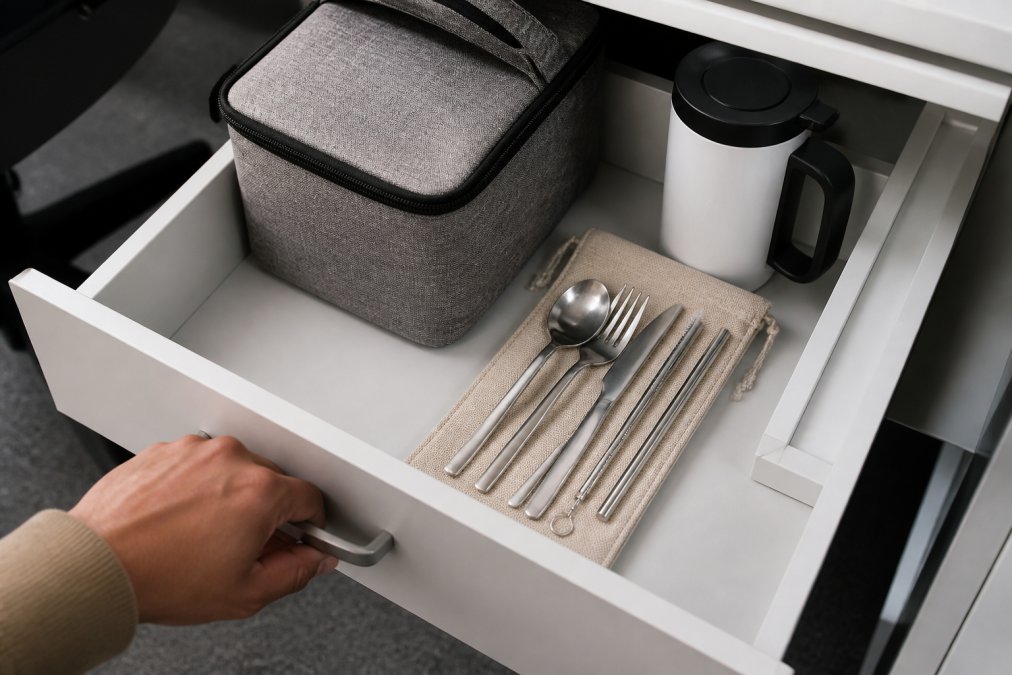
The right corporate gift ideas for employees get used, not shelved. Reusable cutlery sets pass that test because they solve a daily problem.
**ON SALE** 7 Piece Travel Cutlery Set →

Here's the test any gift should pass:
- Does it fit in a lunch bag or backpack?
- Will it survive daily use for years?
- Does it replace something staff already buy?
Conscious Cutlery builds its 7 Piece Travel Cutlery Set around exactly those questions. Each set includes 18/8 food-grade stainless steel utensils, a reusable metal straw, a straw cleaning brush, and chopsticks, all held in a hemp and cotton pouch. The utensils are dishwasher safe, so cleanup takes seconds.
The pouches come in several designs, including a bold "Plastic Sucks" print, a bees pattern, a trees design, and a mandala print. For corporate orders, custom logo printing is available, which turns a practical gift into a walking advertisement for your program.
Pricing starts at $17.99 for the "Plastic Sucks" set and $24.99 for the bees, trees, and mandala designs.
Step 4: Show Staff How to Reduce Plastic Waste at Work
Teaching staff how to reduce plastic waste at work takes ten minutes, not a training session. Keep it practical.
Cover the three habits that matter most:
- Keep the set in your bag or desk drawer, not at home
- Rinse utensils right after use so they never pile up
- Restock the break room reusables weekly so the drawer never runs empty
Step 5: Build Accountability With Incentives, Not Mandates
Then layer three tiers of reward.
- Tier 1, Immediate (day 1 to 14): The reward is the gift. A custom pouch with the team or company mark feels personal, and personal objects get kept. No points, no tracking, no sign-up. The act of receiving is the first reward.
- Tier 2, Social (week 2 to 6): Recognition in a team channel. A "waste watcher" shout-out costs nothing. The mechanism that makes it work is visibility, not the prize, people repeat behavior they were publicly seen doing.
- Tier 3, Group (month 2 onward): Team-level milestones. "The floor that cuts disposable utensil counts the most this month gets first pick of the new pouch designs." Group goals avoid the surveillance problem that kills individual tracking.
A note on the psychological barrier. People resist change when they feel singled out or lectured. Frame the program as a perk, not a policy. "Here's a free set for your bag" lands better than "you must stop using plastic forks." The same object, a custom printed pouch with a logo, reads as a gift in one framing and a compliance tool in the other. The framing is the difference between a program that runs for years and one that dies in a drawer.
Common Mistakes When You Encourage Staff to Use Reusables
The same five mistakes show up in almost every failed program. Avoid them and you're ahead of most offices.
| Mistake | What It Looks Like | The Fix |
|---|---|---|
| No baseline | Handing out sets with no before/after count | Track disposables for one week first |
| Wrong placement | Reusables stored far from the break room | Put them where disposables were |
| No cleaning setup | Shared sink with no soap or drying rack | Add soap and a rack nearby |
| One-time launch | A single email, then silence | Reinforce at day 3, 7, and 30 |
| Mandates over incentives | Rules and penalties | Recognition and light competition |
The Psychological Barriers Nobody Talks About
Most guides treat adoption as a logistics problem. It isn't. It's a habit problem, and habits fail for predictable reasons. Four barriers show up again and again:
- Loss aversion. Staff see a reusable set as something they might lose, forget, or have to clean. The disposable fork has no downside because it's already trash. Counter it by making the reusable set feel replaceable, keep a small reserve of pouches in the break room so a lost one isn't a crisis.
- Identity friction. For some staff, carrying a reusable set reads as "the kind of person who does this." A custom printed pouch with a team or company mark reframes the object as belonging, not as a personal statement. The logo does the identity work.
- Effort asymmetry. The disposable option takes zero steps. The reusable option takes grab, use, rinse, store. Every step you remove raises adoption. Placement and a drying rack remove two of the four.
- Moral licensing. After one good week, people feel they've "done their part" and drift back. This is why the day-3, day-7, day-30 reinforcement pattern matters more than the launch itself.
A Step-by-Step Internal Communication Plan
No top-ranking guide gives managers an actual rollout script. Here's one. Four touchpoints, spread across a month, no nagging.
Frequently Asked Questions
How do you encourage employees to adopt sustainable habits?
Start by removing friction: place reusable utensils where staff already eat, not in a supply closet. Pair access with a short kickoff explaining the why. Then add gentle accountability, like a monthly waste audit posted on a breakroom board. Recognition works better than rules. When people see coworkers using reusables daily, the habit spreads on its own.
What are the benefits of implementing a reusable program in the office?
A reusable program cuts handling costs for disposable utensils, reduces waste hauling fees, and supports your sustainability goals. It also gives employees a visible symbol of your commitment to corporate social responsibility. Many teams report that shared sustainability initiatives improve workplace culture and make it easier to recruit eco-conscious candidates.
Are reusable utensil sets good corporate gifts for employees?
Yes, when they are practical and durable. A stainless steel set in a hemp pouch gets used daily, unlike branded swag that sits in a drawer. Look for 18/8 food-grade steel, dishwasher-safe construction, and a compact pouch that fits a lunch bag. Custom logo printing adds a professional touch for onboarding kits or milestone gifts.
How do you overcome resistance to changing office waste habits?
Resistance usually comes from inconvenience, not disagreement. Address the psychological barriers first: people resist feeling lectured. Frame reusables as a perk, not a policy. Offer a trial period, gather feedback, and let early adopters share their experience. When the change feels voluntary and easy, uptake climbs without mandates.
Getting staff to actually use reusables comes down to removing friction and making the swap worth their while. If your team is ready to try it, start with a set that survives daily life. Conscious Cutlery offers 18/8 stainless steel utensil sets with hemp and cotton pouches, custom logo printing for corporate orders, and a 100-piece minimum that fits most teams. Get started with Conscious Cutlery and give your staff a reusable set they'll actually carry.