

Table of Contents
- Why Reusable Cutlery for Office Lunch Matters
- How to Reduce Plastic Waste at Work
- Choosing the Best Reusable Cutlery for Your Desk
- Top Picks: Conscious Cutlery Sets for the Office
- Keeping It Clean: Dishwasher Safety and Sanitization
- Corporate Sustainability Gifts Your Team Will Actually Use
- The Environmental Impact: A Sustainability Lifecycle Analysis
- Conclusion
- Frequently Asked Questions
Last Updated: September 21, 2026
Why Reusable Cutlery for Office Lunch Matters
Reusable cutlery for office lunch removes hundreds of disposable forks and spoons from the waste stream every year. This guide covers how to choose a set, keep it clean, and make it stick.
A desk worker who eats lunch at the office five days a week burns through single-use plastic without noticing, a fork here, a spoon there, a straw with the iced coffee. It adds up quietly and ends up in a landfill or storm drain.
Below: how to reduce plastic waste at work, which materials hold up best, how to pick a set that survives communal office life, and why so many corporate sustainability gifts end up forgotten in a drawer.
How to Reduce Plastic Waste at Work
The fastest way to cut office plastic is to attack the items you touch daily: cutlery, cups, bottles, and takeout containers. Cutlery is the easiest starting point because it's the most repeated.
Order lunch in three times a week and grab a plastic fork each time, and that's roughly 150 forks a year from one person, thousands of pieces across a floor of thirty.
A few moves that work:
- Keep a reusable cutlery set in your desk drawer or bag so you never need the plastic kind
- Bring a lunch kit with a dedicated spot for utensils so nothing gets lost
- Post a small sign in the break room asking people to skip disposable cutlery
- Swap plastic water bottles for a refillable one at the same time
The EPA's guidance on reducing waste at work outlines how source reduction beats recycling every time. Skipping the disposable fork in the first place is the whole game.

Choosing the Best Reusable Cutlery for Your Desk
The best reusable cutlery for a desk is a compact, dishwasher-safe set with a storage pouch, it survives being tossed in a bag and cleaned in a communal sink without rusting or bending. But the sets that actually get used daily are the ones that feel right in your hand and fit the lunch system you already carry.
What most people get wrong is buying the cheapest set they can find, then wondering why the fork bends on a salad.
Material Matters: Stainless Steel vs. Bamboo vs. Plastic
Stainless steel is the material that holds up. Look for 18/8 food-grade steel: it resists rust and corrosion, doesn't pick up flavors from yesterday's soup, is dishwasher safe, and won't splinter or crack. The "18/8" chromium-to-nickel ratio keeps the steel from pitting in a damp pouch.
| Material | Durability | Dishwasher Safe | Best For |
|---|---|---|---|
| 18/8 Stainless Steel | High, resists rust and pitting | Yes | Daily office use |
| Bamboo | Moderate, can mold and splinter | Hand wash only | Occasional use |
| Reusable Plastic | Low, warps and stains | Often warps | Not recommended |
Size and Weight: Finding the Perfect Fit for Your Lunch Bag
Standard 7-inch utensils are the sweet spot: long enough for a real meal, short enough to slide into a lunch bag or backpack side pocket. Under 6 inches feels like a camping spork; over 8 inches won't fit most insulated bags.
Integrating With the Lunch System You Already Carry
A cutlery set only works if it fits the bag you actually bring. Before you buy, measure the internal width of your lunch bag's side pocket or your bento box's utensil slot, most standard bento boxes and insulated totes have a slot sized for a 7-inch utensil.
Weight Balance and Feel: What to Check Before You Buy
If you can hold a set before buying, do three quick checks:
- Balance test: Rest the fork across your index finger. A well-made utensil balances near the middle of the handle, not the very end.
- Grip test: Close your hand around the handle. If your fingers wrap around and touch your palm, the handle is too thin.
- Flex test: Press the tines gently against your thumb. A flimsy fork flexes noticeably; good 18/8 steel won't.
Top Picks: Conscious Cutlery Sets for the Office
Conscious Cutlery builds 7-piece stainless steel sets designed for exactly this use case: a desk, a lunch bag, and a communal sink. Every set includes a fork, spoon, knife, 6mm reusable straw, straw cleaning brush, chopsticks, and a pouch.
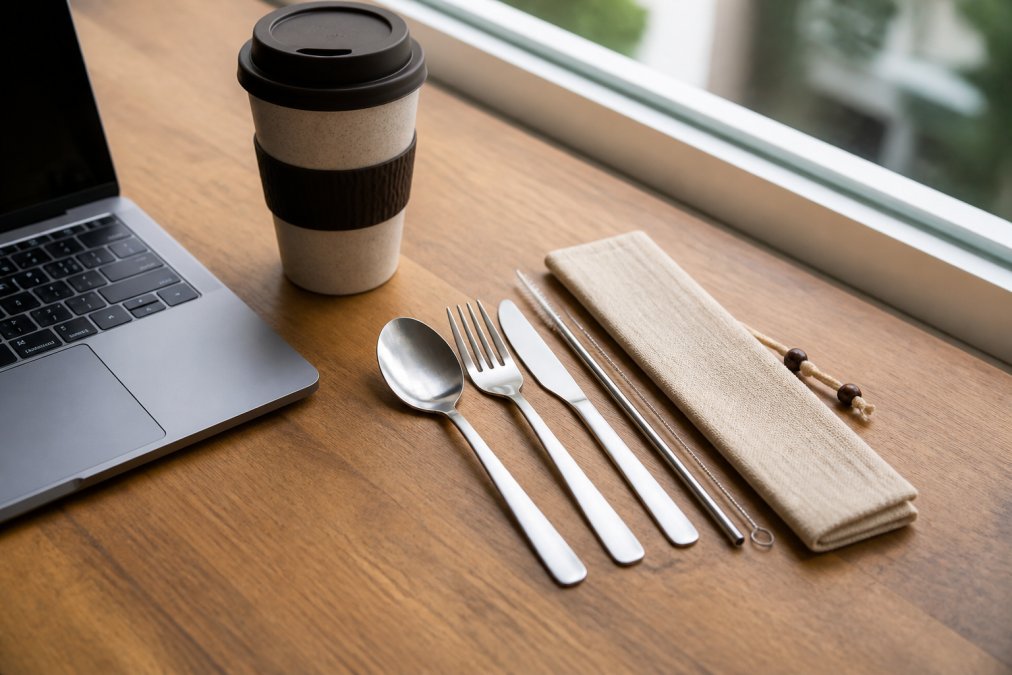
Here's how the lineup breaks down.
7 Piece Travel Cutlery Set With Hemp →
Keeping It Clean: Dishwasher Safety and Sanitization
Every Conscious Cutlery stainless steel set is dishwasher safe. The neoprene pouches are also dishwasher safe. That's the single biggest reason these sets survive office life.
The protocol that works in a shared kitchen:
- Rinse utensils under hot water immediately after eating so food doesn't dry on
- Place them in the dishwasher basket, not loose in the silverware caddy where they can fall through
- If hand washing, use hot water and dish soap, then air dry completely before returning them to the pouch
- Wipe the inside of the pouch with a damp cloth weekly, and let it dry fully before zipping it closed
Corporate Sustainability Gifts Your Team Will Actually Use
Corporate sustainability gifts fail for one predictable reason: they're chosen for the logo, not the person receiving them. A branded tote bag gets left in a conference room; a reusable cutlery set gets used every single day.
Why Most Branded Swag Gets Left Behind
The pattern is consistent. A company orders a few hundred branded items, hands them out at an event, and within a month most are in a drawer or trash can. The reason isn't that people dislike free stuff, it's that the item doesn't fit any existing routine.
Personalization That Actually Drives Use
A logo on a pouch does two things at once: it makes the set feel like a gift rather than office property, and it gives the recipient a reason to keep it rather than lose it in a communal drawer.
A few things that make a corporate order work:
- Choose a pouch design that fits your brand, or ask about custom logo printing
- Order enough that people can keep one at the desk and one in the bag
- Hand them out with a short note explaining the goal, because context drives use
- Pair the gift with a simple ask, like "skip the plastic fork for a month"
Planning a Bulk Order: What to Know Before You Commit
Custom printed pouches for corporate gifts, wedding favors, and fundraising items all follow the same production path, and knowing the steps prevents surprises.
- Pick the pouch style. A nature-themed pouch reads well for a sustainability initiative; a cleaner geometric design reads better for a client-facing gift.
- Confirm the print area. Logo placement is limited by the seams and closure. Simple, single-color marks reproduce most cleanly.
- Set the quantity. The minimum order is 100 pieces, which works well for a department, a new-hire welcome kit, or a college bookstore stocking up for incoming students.
- Allow for production time. Custom printing adds lead time, so plan around your event or distribution date rather than the other way around.
Where These Orders Fit Beyond the Office
The same pouch that works as an employee gift also works for a wedding favor table, a fundraising auction, or a college bookstore shelf. Schools buy them in volume for incoming freshman orientation packets, where a durable, useful item beats a paper brochure every time. The 100-piece minimum lines up naturally with a single dorm floor, a small department, or a mid-sized event.
The Environmental Impact: A Sustainability Lifecycle Analysis
A sustainability lifecycle analysis of reusable cutlery comes down to one number: how many times you use it. Every reuse is a disposable utensil that never gets made.
The lifecycle picture has three stages:
- Production: Steel takes energy and raw material to make, so the set carries an upfront footprint. That's the honest trade-off.
- Use phase: This is where the set earns its keep. Every meal is a zero-waste lunch, and the footprint per use drops with every repetition.
- End of life: Stainless steel is highly recyclable, so the material has a second life after the set is retired.
That's the argument for buying a set that lasts.
Conclusion
The hardest part of going zero waste at the office isn't finding a good set. It's building the habit so the set is always with you when lunch shows up.
Frequently Asked Questions
What is the best silverware set for a lunchbox?
The best set for a lunchbox is compact, durable, and easy to clean. A 7-piece stainless steel set with a pouch, like those from Conscious Cutlery, is ideal. It includes a fork, spoon, knife, straw, cleaning brush, and chopsticks, all fitting neatly into a small hemp or cotton pouch that slides into any lunch bag.
How do you keep reusable utensils clean at work?
Rinse your utensils immediately after use to prevent food from drying. If your office has a dishwasher, check if the set is dishwasher safe; many stainless steel sets are. Otherwise, wash with warm soapy water in the break room sink. A quick wipe with a napkin before storing them in their pouch keeps them hygienic until you get home.
What are some good reusable utensil sets with a case?
Conscious Cutlery offers several 7-piece sets with eco-friendly pouches made from hemp, cotton linen, or limestone neoprene. These sets include a fork, spoon, knife, straw, straw brush, and chopsticks. The pouches are compact, lightweight, and designed to fit in a purse, backpack, or desk drawer, making them perfect for office lunches.
Are stainless steel utensils safe for daily use?
Yes, 18/8 food-grade stainless steel is safe, rust-resistant, and durable for daily use. It does not leach chemicals like some plastics can, and it is easy to sanitize. Choosing a set made from 18/8 stainless steel ensures it will last for years, reducing waste and saving money on disposable alternatives.